Imagine investing thousands or even millions of naira into your poultry farm only to have rats quietly undermine your efforts every night. They sneak into feed stores, contaminate drinkers, chew electrical wiring, damage buildings, spread disease and stress your birds all while remaining largely unseen.
Many poultry farmers think rodent control begins when they see a rat. In reality, by the time you notice one, there are often many more hiding nearby. Rodent control is not simply about killing rats. It is an essential part of poultry biosecurity that protects bird health, farm assets and profitability.
What is rodent control?
Rodent control is the systematic process of preventing, monitoring and reducing populations of rats and mice around poultry farms. It combines sanitation, exclusion, habitat management, monitoring and appropriate control measures to make the farm unattractive to rodents. The goal of controlling rodent is to ensure prevention not reaction.
Why rodents are biosecurity threat?
Rodents are much more than nuisance animals, they are opportunistic pests that thrive wherever food, water, and shelter are available – a poultry farm provides all three.
Rodents, because they move freely between drains, refuse dumps, feed stores, neighboring farms and poultry houses, can carry disease-causing organisms directly into your production environment. This makes them an important link in the chain of disease transmission, thereby making them a major threat to poultry farms.
How rodents threaten poultry farms
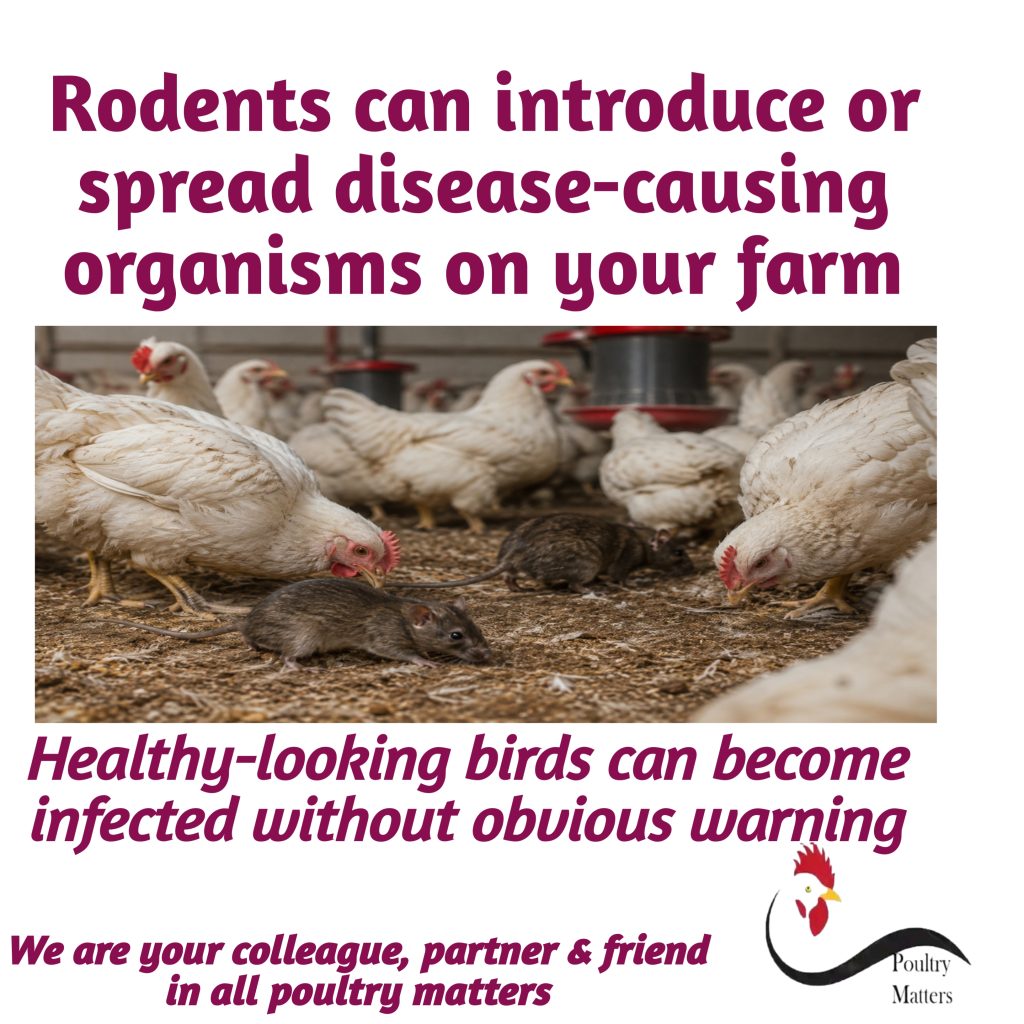
They spread diseases – Rodents can introduce or mechanically spread numerous disease-causing organisms throughout a poultry farm. As they move through contaminated environments, pathogens can be carried on their feet, fur, urine, saliva and droppings.
These organisms may contaminate:
- Poultry feed
- Drinking water
- Feeders
- Drinkers
- Equipment
- Egg trays
- Poultry houses
Disease transmission can occur long before farmers notice obvious clinical signs in birds.
They contaminate more than feed than they eat – Many farmers underestimate the true cost of rodent feeding.
Rodents may consume relatively small amounts of feed but they contaminate much larger quantities. Feed contamination occurs through the rodents –
- Urine
- Droppings
- Hair
- Saliva
Once contaminated, feed quality declines and disease risk increases. The result is wasted feed, higher production costs, and poorer flock performance.
They damage farm infrastructure – A rodent’s teeth grow continuously throughout its life – To keep them worn down, rodents constantly chew. Their common targets in the poultry farm include:
- Electrical wiring
- Feed bags
- Wooden structures
- Plastic water pipes
- Insulation materials
- Doors
- Storage facilities
The damage caused by the rodents chewing on these items result in –
- Costly repair works
- Pipes damage and water leakage
- Feed losses – feed spillage and feed contamination
- Electrical faults due to damaged wire
- Fire hazards (possibly from electrical sparks)
Many times the damage caused by rodents exceeds the cost of the feed they consume.
They stress poultry – Rodents are most active at night—the same time birds should be resting.
Constant movement and noise disturb poultry and contribute to unnecessary stress. Stress can result in:
- Reduced feed intake
- Slower growth
- Lower egg production
- Poor feed conversion
- Reduced overall productivity
Healthy birds require a calm environment to perform optimally.
Rodents increase production costs – Every bag of contaminated feed, damaged electrical cable, repair cost, decline in farm
Warning Signs of Rodent Problem
Rodent problems rarely begin with seeing a rat running across the poultry house in broad daylight. In most cases, rodents are active when the farm is quiet, moving through hidden spaces and gradually establishing themselves around feed stores, poultry houses, equipment rooms and waste areas.
This is why early detection is one of the most important parts of rodent control. By the time rodents become comfortable enough to be seen regularly, the population may already be established. Smart poultry farmers therefore do not wait to see a rat before taking action. They learn to recognize the small signs that indicate rodent activity and investigate them immediately.
Rodent droppings – One of the clearest signs of rodent activity is the presence of droppings around feed storage areas, beneath feed bags, along walls, behind equipment, under shelves, near drinker lines, around openings, and in other quiet areas where rodents can move undisturbed.
Fresh droppings may indicate recent activity, while older droppings suggest that rodents have been using the area repeatedly. Do not dismiss a few droppings as insignificant. A small amount of visible evidence can be an early warning of a much larger hidden problem.
Gnawing and chewing marks – Rodents have continuously growing incisors and regularly gnaw materials to maintain them. This explains the chewing marks around the farm on wooden structures, feed containers, plastic materials, doors, storage boxes, electrical cables and other vulnerable materials. Give particular attention to electrical wiring because rodent damage to cables can create equipment problems and potentially increase the risk of electrical faults or fire.
The truth is that rodent damage is not merely a maintenance issue; it can become a farm safety and operational problem.
Greasy streaks and rub marks – Rodents frequently travel along walls, edges, corners and established pathways. As they repeatedly pass through these routes, oils and dirt from their bodies can leave dark or greasy marks on surfaces. These marks may appear along walls, around openings, behind equipment, or near frequently used rodent pathways. A single mark may not confirm an active infestation, but repeated streaks in protected areas should prompt further investigation.
This is particularly useful because rodents are often difficult to observe directly. Their travel routes may reveal their presence even when the animals themselves remain hidden.
Unexplained damage of farm material – Rodents do not only target feed. Their activities can result in unexplained damage to materials around the farm. Check wooden structures, insulation, plastic containers, storage materials, cartons, and other items kept in quiet or poorly monitored areas. Repeated damage in hidden corners or along walls should raise suspicion, especially when it occurs close to available food and water. Farmers should investigate the cause rather than simply repairing the damage. Repairing a damaged structure without addressing the rodent activity behind it only treats the symptom, not the problem.
Unusual noises at night – Rodents are generally more active during periods of darkness and reduced human activity. Farmers may therefore hear scratching, gnawing, rustling or movement in ceilings, walls, storage areas or other concealed spaces. Hearing unexplained movement repeatedly at night should not be ignored rather, investigate the suspected area during daylight rather than disturbing the animals at night. Look for accompanying signs such as droppings, gnaw marks, nesting materials, or disturbed feed. A noise by itself does not prove that rodents are present but repeated unexplained sounds combined with other signs are a strong reason to investigate.
Practical Rodent Control Measures
An effective rodent control program combines several strategies rather than relying on a single method.
Maintain excellent sanitation – Good sanitation removes what rodents need most – Food and hiding space. A clean environment discourages rodent activity, therefore –
- Clean up spilled feed immediately.
- Remove unnecessary clutter.
- Dispose of waste properly.
- Keep vegetation around buildings trimmed.
- Store equipment neatly.
Store feed properly – Feed should never be left exposed. Ensure proper storage system through the following –
- Use rodent-resistant storage containers or secure feed stores.
- Repair torn feed bags immediately.
- Rotate stock regularly.
- Avoid overnight feed spillages.
Eliminate possible rodent entry points- Rodents enter through surprisingly small openings, therefore, it is necessary to regularly inspect building for: cracks, holes, damaged vents, broken doors and gGaps around pipes.
Seal openings using durable rodent-resistant materials.
Remember: If rodents cannot enter, they cannot establish themselves.
Remove hiding places – Rodents prefer undisturbed areas, therefore, reduce their shelter by –
- Cutting grass around poultry houses
- Removing unused materials
- Organizing storage areas
- Keeping surroundings clean
Less shelter means fewer opportunities for rodents to breed
Use traps and bait stations correctly – Traps and bait stations can help reduce rodent populations when used as part of a broader control program. Place them:
- Along walls
- Near burrows
- Around feed stores
- Along rodent travel routes
Never place rodenticides where poultry, pets, wildlife or children can access them. Always follow the product label and local regulations.
Monitor continuously -Rodent control is not a one-time activity. It recommended to inspect your farm routinely for fresh signs of activity, document observations and review bait consumption. Early intervention prevents major infestations.
Train farm workers – Every worker plays an important role in biosecurity, therefore, it is necessary them to –
- Report rodent sightings immediately
- Clean feed spillages promptly
- Close feed stores properly
- Protect bait stations from disturbance
- Follow sanitation procedures consistently
Rodent control succeeds when everyone participates.
Rodent control is profit protection
Many farmers see rodent control as pest management. However, the smart poultry farmers see it differently and understand that controlling rodents protects:
- Bird health
- Feed quality
- Farm equipment
- Production efficiency
- Biosecurity
- Profitability
Every rodent prevented from entering your poultry house is one less opportunity for disease, contamination and unnecessary financial loss.
Conclusion
Rodents are persistent, therefore, your rodent control program must be even more persistent. The most effective poultry farms are not those that react after rodents become a problem – they are the farms that make rodent prevention part of their daily biosecurity routine. Remember, a successful rodent control program is not built on traps alone, it is built on consistent sanitation, exclusion, monitoring, documentation and teamwork.
Protect your birds before rodents move in.
Download this biosecurity checklist to support your process https://drive.google.com/file/d/1S8WgeWiv5BM35XxgC2mMrr5bIXuOM4vJ/view?usp=sharing
Read more on biosecurity https://poultrygist.com.ng/internal-and-external-biosecurity-in-poultry-farming-why-you-need-both-to-protect-your-flock/