Feed is more than an input. It is one of the biggest financial decisions you make on the poultry farm
A poultry farm can have healthy birds, good sales, and strong revenue—and still struggle to make a worthwhile profit. Why? – Because revenue is not profit.
In your poultry business, what matters is not only how much you sell, but how efficiently you convert your production inputs into saleable output. Since feed is often one of the largest costs in poultry production, the way you purchase, store, handle, allocate and monitor feed can have a significant impact on your bottom line. This is where smart feed management becomes a business strategy. Your farm operations is not simply about making sure birds have enough feed. It is about ensuring that the feed you pay for delivers as much productive value as possible.
Feed cost –The profit factor you cannot afford to ignore
When farmers think about poultry profitability, attention often goes to selling price, bird weight, egg price, or market demand. Those things matter but profitability is also heavily influenced by what happens before the product reaches the market. Every bag of feed represents money invested in production – If part of that feed is spilled, spoiled, contaminated, poorly stored, wasted or consumed inefficiently, your farm still pays for it but may not receive the expected productive return.
That means the real question is not: “How much feed did I buy?” but a better question is: “How much productive value did my farm get from the feed I bought?” That shift in thinking is fundamental to profitable poultry farming.
Feed wasted if profit wasted –
Feed waste can look insignificant on the farm in the following forms –
- A little feed around the feeder.
- A small amount spilled during distribution.
- Some feed left exposed in storage.
- A few bags damaged by poor handling.
Individually, these losses may appear too small to worry about but poultry farming is a volume business. Small daily losses can accumulate into significant financial losses over weeks and months. There is something important to remember- You paid for wasted feed at the same price you paid for usable feed and wasted feed does not produce any value to boost your farm – That makes feed wastage one of the simplest profit leaks to identify and control.
Practical ways to improve feed efficiency on your farm –
Buy appropriate and quality feed – The cheapest feed is not always the lowest cost feed
Cost control does not simply mean buying the cheapest feed available – that can be a costly mistake. A lower-priced feed may appear attractive at the point of purchase but if birds require more of it to achieve the desired growth or production, the apparent saving may disappear. This is why poultry entrepreneurs should think beyond price per bag, rather, consider the bigger picture – How much does it cost to produce a kilogram of live weight? Or:How much feed is required to produce a dozen or tray of eggs?
This is where feed efficiency becomes important. A feed that costs slightly more per bag but supports better performance may provide better economic value than a cheaper feed that produces poorer results.
Monitor flock feed intake – what you don’t measure can cost you
One of the most overlooked aspects of feed management is monitoring consumption. If you do not know how much feed your flock is consuming, it becomes difficult to identify problems early. Unexpected increases in feed consumption can signal issues such as:
- Feed wastage
- Poor feeder management
- Environmental stress
- Changes in flock condition
- Poor feed quality
- Management problems
Similarly, an unexpected reduction in feed intake can also require investigation. Your farm records should therefore connect feed usage with flock performance, therefore track –
- Feed supplied
- Feed consumed
- Number of birds
- Mortality
- Body weight or growth
- Egg production, where applicable
- Feed conversion or other relevant efficiency indicators
Feed Conversion
In your poultry feeding management, it is important to look beyond the fact that the birds are eating well because that a flock is eating well does not necessarily imply the flock is profitable. In your poultry feed management, what matters is what your flock produces (Feed Conversion).
Feed Conversion Ratio (FCR) is one of the important measures farmers can use to evaluate feed efficiency, particularly in meat production. In simple terms, FCR relates the amount of feed consumed to the amount of weight gained – For example, if a flock requires significantly more feed to achieve the same weight gain as another flock, the higher feed requirement can put pressure on profitability.
This is why feed management should not stop at: “Are my birds eating?”
The better question is: “What are my birds producing from the feed they are eating?”
That is the difference between simply feeding birds and managing feed for performance and profit.
Feed Storage –
Good feed storage helps to protect you investment. Feed management begins before the feed reaches the feeder.
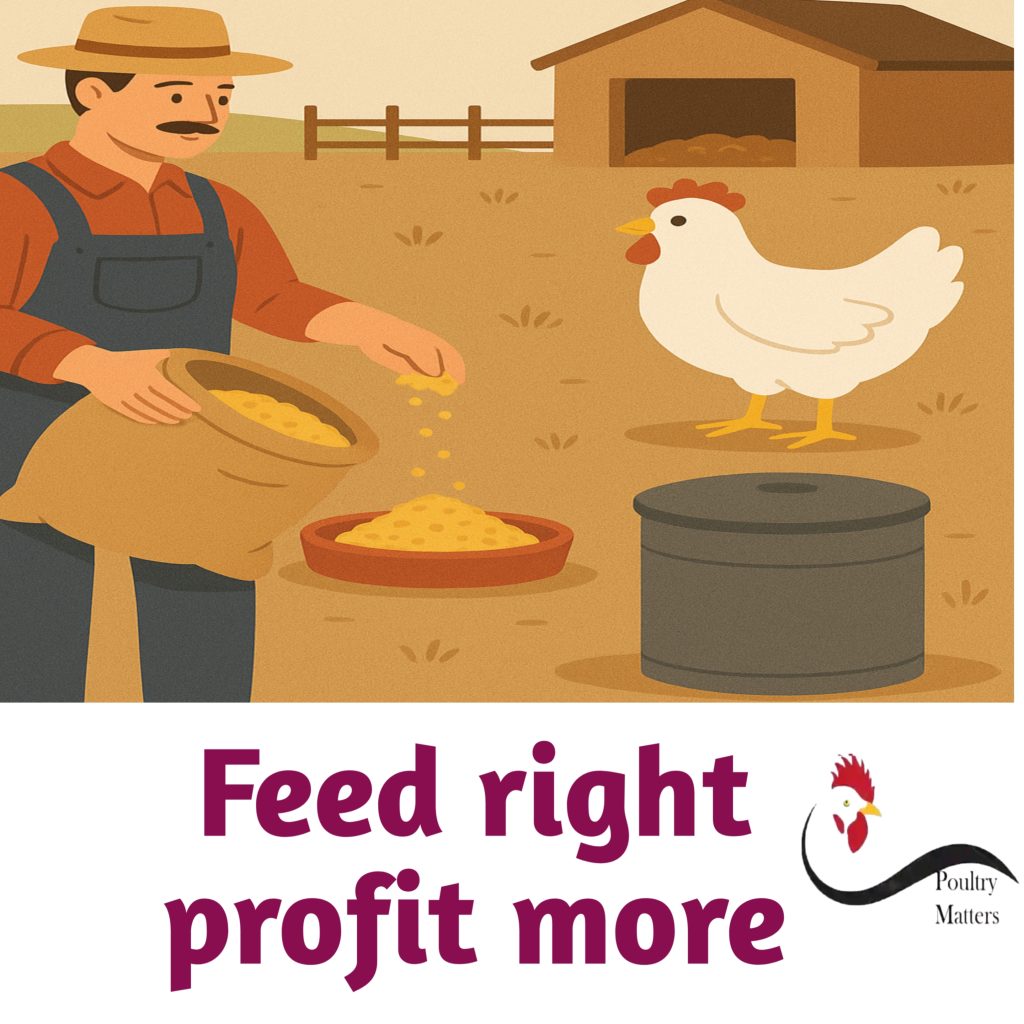
Poor storage can turn valuable feed into a financial loss, Feed should be protected to maintain its nutritional and economic value. It is necessary to protect the feed frome –
- Moisture
- Direct contact with the floor
- Rodents
- Insects
- Excessive heat
- Poor ventilation
Store feed in a clean, dry and well-managed environment, ideally, on pallets or raised platforms to keep bags away from direct floor contact and allow adequate airflow. Also practice FIFO, a stock rotation, system so that older feed is used appropriately rather than forgotten at the back of the store (First in, First out)
Note- You cannot protect your feed cost if you do not protect the feed itself.
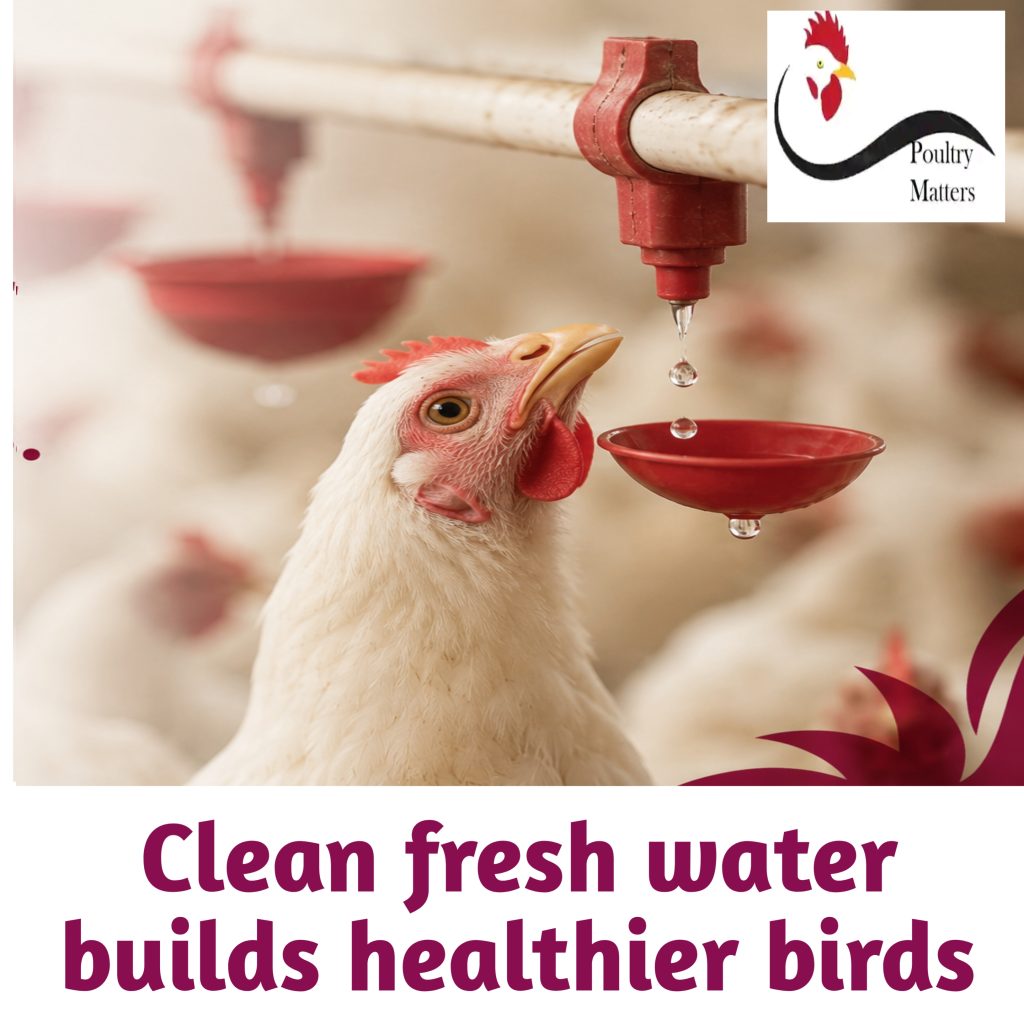
Feed management and water management work together – Smart feed management cannot be separated completely from water management. Birds need adequate access to good quality water for normal feed consumption and physiological functions.
If water availability or quality is compromised, feed intake and flock performance can also be affected. That means a farmer focusing heavily on feed while neglecting water may be addressing only part of the problem – Good feed + poor water management = compromised performance.
Effective poultry management considers everything involved in the whole system.
Your record is a strategic for profit control –
Feed management becomes much more powerful when it is supported by accurate records. Your accurate record helps you vital questions such as –
- How much feed did we purchase?
- How much feed did the flock consume?
- How many birds are currently on the farm?
- What is the mortality rate?
- What is the average weight or production level?
- How much feed is being used per bird?
- Are we seeing unusual changes in consumption?
- How does current feed efficiency compare with previous cycles?
Without reliable records, it is easy to make decisions based on assumptions. Valid record helps you identify trends and investigate problems before they become leaks to the farm profit.
Record keeping is not paperwork for paperwork’s sake. It is financial intelligence for the farm.
Conclusion
Many poultry farmers focus heavily on the selling stage. They want better prices, more customers, more sales and more revenue. Those are important but profitability is not created at the point of sale alone, rather, it is protected throughout production-
- Smart poultry feeding is not simply about feeding birds correctly. It is about managing one of your farm’s most important production investments. The goal is not to feed more or buy the cheapest feed but to ensure that every kilogram of feed purchased delivers as much productive value as possible. Therefore, the poultry entrepreneur must –Buy wisely
- Store properly
- Feed correctly with age-appropriate feed
- Reduce waste and improve feeder management
- Monitor consumption
- Measure performance
- Use records to enhance better decision process
Note that revenue only tells you what came into the business. Profit tells you what remained. Smart feed management helps you protect profit effectively.
Feed smart. Control costs. Protect your profit. Build a sustainable poultry business.